


Industrial Systems Integration: The Hidden Complexity of the Energy Transition

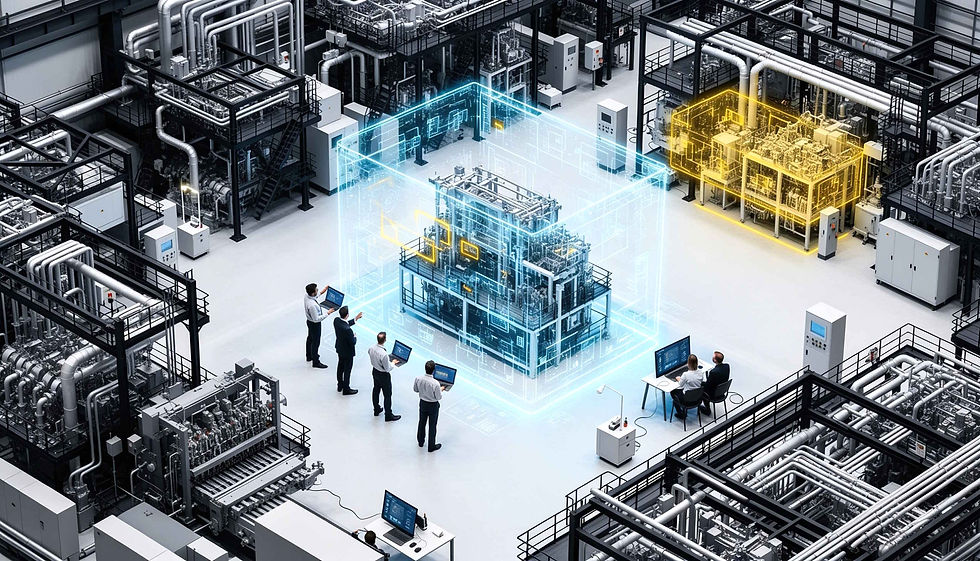
Looking Beyond Technology in the Energy Transition
Across industrial and manufacturing sectors, conversations around the energy transition have become increasingly common. Energy security, process electrification, hydrogen, renewable sources and alternative generation technologies are now shaping investment strategies, engineering decisions and long-term industrial planning across a wide range of industries.
Most of these discussions understandably focus on technology. Which solutions are most promising? Which will scale faster? Which will play a significant role in the future energy landscape? These are legitimate questions, but they often leave another critical dimension in the background: what happens when those technologies must be implemented within existing industrial facilities and infrastructure.
From an applied engineering perspective, this is where a different reflection emerges. Once a technology has been validated on technical, economic or environmental grounds, another challenge begins: integrating it into industrial systems that have evolved over years — sometimes decades — under entirely different operational assumptions. In our experience, many of the most complex challenges concentrate in this phase of industrial systems integration.
This is not intended as a universal truth, nor as a comprehensive account of the energy transition. It is an observation shaped by experience with retrofit projects, plant modernization initiatives and industrial systems integration activities, where technology availability often represents only the starting point. From this perspective, the primary challenge may not be access to new energy technologies, but rather the ability to integrate them effectively into complex industrial environments — where even a seemingly limited modification can generate consequences well beyond the scope of the original intervention.
he Technologies Exist. Industrial Systems Integration Is the Real Challenge
Over the last decade, energy-related innovation has progressed significantly. Technologies continue to improve, performance levels increase and new solutions emerge at a rapid pace. From this standpoint, technological progress appears both steady and difficult to arrest.
The picture changes, however, when these technologies must operate within real industrial environments. In most cases, they are not deployed within greenfield facilities designed specifically around them. Instead, they must coexist with existing infrastructure, established production processes, legacy systems and operational procedures originally developed to address very different requirements.
In these situations, the challenge is no longer limited to the technology itself. The critical question becomes whether it can be integrated effectively into the existing industrial ecosystem. A solution may be technically mature and economically viable, yet still encounter significant implementation difficulties — not because of any intrinsic limitation, but because introducing it requires a thorough understanding of the relationships and dependencies already present throughout the system.
Installing Is Not the Same as Integrating
In everyday language, installation and integration are often treated as interchangeable. From an engineering standpoint, however, they represent fundamentally different activities.
Installing a new technology means adding a component, a piece of equipment or a subsystem to an existing facility. Integrating that technology means understanding and managing the effects its presence will have across the broader operational environment.
This is precisely where industrial systems integration becomes critical. Every modification creates new interactions between elements that previously operated independently. A seemingly localized change can affect automation logic, operating conditions, maintenance strategies, safety requirements and technical documentation. It may require new procedures, additional validation activities and, in some cases, competencies that were not previously needed.
For this reason, integration should never be viewed as a simple extension of installation. It demands a systemic perspective and the ability to evaluate not only what is being added, but everything that may be indirectly affected by that addition. The more complex the system, the more consequential effective integration becomes.
When a Retrofit Becomes a Redesign
One recurring theme in industrial retrofit and plant modernization projects is the tendency to underestimate complexity during early planning. Many interventions are initially approached as relatively contained upgrades, with the expectation that the existing system will absorb the proposed changes without significant disruption.
Sometimes this assumption holds. Often, however, the scope expands as the project progresses.
When a new technology substantially alters operating conditions, engineers may be required to reassess aspects that initially appeared unrelated to the intervention. Safety analyses, control strategies, technical documentation, maintenance procedures and operational workflows may all need substantial revision. At that point, the project gradually stops resembling a retrofit and begins to take on the characteristics of a full redesign.
Importantly, this is not necessarily driven by the complexity of the new technology itself. More often, it reflects the complexity of the environment into which that technology must be integrated. The more layered and interconnected an industrial system has become over time, the greater the likelihood that a local modification will produce far-reaching effects across the broader operation.
Complexity Grows at the Interfaces
When discussing industrial complexity, attention tends to fall on the number of components, assets or subsystems involved. From our perspective, however, complexity grows primarily at the interfaces between those elements.
Every new technology introduces not only additional equipment, but additional relationships that must be understood, coordinated and maintained over time. These interfaces may be technical, operational or organizational. They can involve interactions between mechanical and electrical systems, between automation and production processes, between engineering and maintenance functions — or span multiple suppliers, consultants, regulatory bodies and internal stakeholders with differing priorities.
It is often at these points of contact that the most difficult challenges in industrial systems integration emerge.
Viewed through this lens, complexity increases not because there are more individual elements within the system, but because there are more connections between them. Each connection creates an additional requirement for coordination, alignment, validation and management. This is where engineering moves beyond purely technical considerations and takes on a strongly organizational and multidisciplinary character.
Is the Real Challenge Organizational Rather Than Technological?
If we had to identify a recurring factor behind the difficulties encountered in many industrial transformation projects, we would not point to technology itself.
Technical solutions continue to evolve and, in most cases, are fully capable of delivering the intended outcomes. The more significant challenges tend to emerge elsewhere: in the coordination of disciplines, the management of information, the alignment of stakeholders and the integration of specialized expertise into a coherent project vision. They arise when production requirements, regulatory constraints, economic considerations and operational realities must be reconciled without compromising the continuity of the facility.
For this reason, we tend to view the energy transition not only as a technological challenge, but as an industrial systems integration challenge — one that demands coordination, systems thinking and complexity management every bit as much as it requires technical innovation. Technologies will continue to evolve. The ability to implement them successfully will depend increasingly on the quality of the processes, organizations and people responsible for integrating them.
A Final Reflection
The public debate surrounding the energy transition will likely continue to focus on energy sources, emerging technologies and future generation models. These discussions are necessary and will remain important.
From an industrial engineering perspective, however, another dimension deserves equal attention: the ability to translate technological innovation into practical, operational outcomes through effective industrial systems integration.
Based on what we have observed, many of the most significant challenges do not stem from a lack of adequate technology. They stem from the need to coordinate people, competencies, organizations and constraints that often operate according to different priorities and objectives. This work may be less visible than developing a new technical solution, but it is no less consequential.
Perhaps the most relevant question is not simply which technologies will shape the future of energy. It may be whether we can integrate those technologies effectively into industrial environments that cannot be redesigned from scratch each time innovation emerges.
In our view, it is within this space — between technology and industrial systems integration — that a significant part of the true complexity of the energy transition resides.


Comments