


Automation and Mechatronics in Industrial Machine Simplification

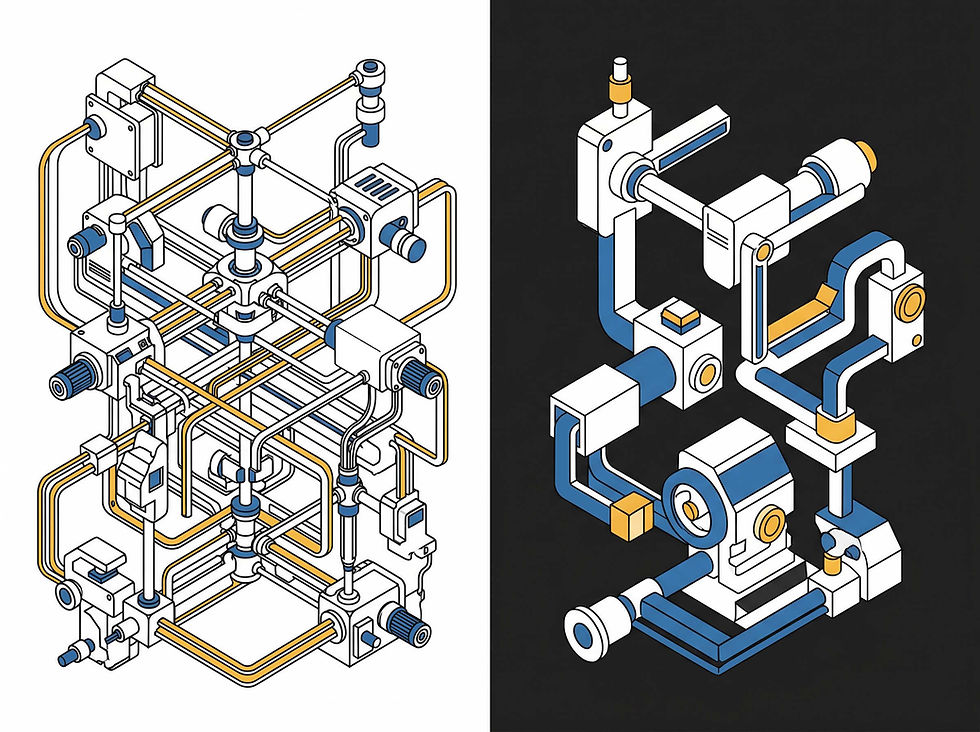
Growing Integration
In recent years, industrial automation has evolved toward increasingly distributed systems, where intelligent components, continuous device communication and integration between electronics, pneumatics and software are profoundly redefining how machines are designed and built. Connected solenoid valves, decentralized drives and integrated logic systems progressively move intelligence from the control cabinet directly onto the machine, transforming architectures from centralized to distributed across the entire system.
This evolution is often interpreted as simplification: reduced wiring, increased modularity, faster configurations and an overall perception of improved design order. However, this simplification is only apparent. Reducing physical complexity does not eliminate the problem — it simply transfers it to another layer: the logical one. Every intelligent component introduces states, parameters, operating conditions and dependencies that must be understood, integrated and maintained over time. Interactions increase, abstraction layers grow and the machine, while appearing cleaner from a construction standpoint, becomes functionally denser.
The issue is therefore not how technologically advanced a machine is, but whether it remains understandable and governable as a whole.
Limits of Control
The issue becomes clear when control systems are used to compensate for a process that is not inherently stable. Under these conditions, technology no longer guides the system, but continuously sustains its behavior.
A typical example can be found in articulated transport systems, where multiple conveyors are synchronized through distributed sensors in order to align components along the production flow. The principle itself is correct, but implementation often generates a continuous sequence of local corrections. Each sensor detects a condition and activates a response, creating a chain of events governed not by a single logic, but by the interaction between multiple control points.
The system stops being deterministic and becomes reactive. This leads to asynchronies between different elements, uncoordinated stops, misalignments and jams during transitions between sections. Even when operation is technically maintained, regulation becomes complex and diagnostics less immediate, since the observed behavior results from multiple simultaneous interactions.
In this scenario, control is not simplifying the process, but attempting to keep it in equilibrium — a symptom of complexity that has not been solved, only contained.
Stability and Industrial Machine Simplification
When complexity is addressed upstream, machine behavior changes radically and the role of automation naturally becomes more selective. In the analyzed case, the solution was not an improvement of sensor logic, but a structural redesign of the system itself. By reducing the number of conveyors, eliminating redundant sensors and introducing a mechanical constraint, component alignment became a direct consequence of physical configuration alone.
This represents a key principle: industrial machine simplification is not a reduction in performance, but a design choice aimed at achieving more stable and predictable behavior. The system no longer requires continuous corrections because it no longer generates the conditions that make them necessary. Control logic becomes concentrated in a specific point instead of being distributed across the entire process, making the overall operation more readable and governable.
Within this approach, mechanical design regains a central role. Geometry, kinematics and constraint management define machine behavior before control systems intervene. Automation is introduced only where unavoidable variability or real discontinuities must be managed. Everything that can be physically determined is not delegated to software logic.
Two Logics Compared
The issue is not technological, but methodological. There are two distinct ways of approaching complexity, and the difference becomes evident once the machine enters operation.
The first approach builds systems based on extensive distributed integration. Components continuously communicate with each other, control is diffused and overall behavior emerges from interactions between multiple nodes. This model offers high theoretical flexibility and adapts well to environments where variability is elevated and not entirely predictable. However, it also introduces a significant number of operating conditions and makes system interpretation more difficult, especially during anomalies.
The second approach intervenes directly on process structure. Discontinuities are reduced, critical points minimized and deterministic behavior is established at the design stage itself. Control systems do not disappear, but are used selectively as management tools rather than compensatory mechanisms. The result is a machine that is more stable, predictable and easier to manage.
The difference between these models becomes even more evident in existing plants. In contexts where machines were designed years earlier and rely on consolidated logic, the massive introduction of intelligent components can create more problems than it solves. Overlaying additional control layers onto structures not originally conceived to support them increases operational complexity without generating meaningful performance improvements. Conversely, in newly designed systems, integration can only be effective when it originates from a coherent architectural logic rather than from the accumulation of isolated solutions.
A Design Choice
Automation is not the starting point of the project, but a direct consequence of how the machine has been conceived. When a system is inherently stable, control becomes a support element used only where real discontinuities must be managed. When stability is instead delegated to control systems, machines become dependent on their own complexity, and every intervention requires deep understanding of all interactions involved.
This is where project quality is truly defined. Not between more or less advanced technologies, but between an approach that accumulates solutions to compensate for variability and one that works to reduce variability at its source. In a context where technological availability continues to expand, competence does not lie in adopting everything that is possible, but in selecting only what is necessary according to the required result.
A well-designed machine is not the one integrating the highest amount of intelligence, but the one requiring less intelligence to operate reliably while maintaining understandable and controllable behavior over time. It is a subtle difference, yet operationally decisive, because it impacts not only the design phase, but the entire lifecycle of the system.


Comments